What Wildlife Removal Costs in Fort Worth
Nobody can quote your job from a web page, and any site that gives you a single confident number is guessing. What we can do is show you the published national ranges, explain honestly what moves the price, and tell you what a quote should include.
The published national ranges, by job
These come from national cost guides, not from us and not from other Fort Worth companies. They are a starting point for orientation, not a Fort Worth quote. Each job below links to the page that explains the work.
Raccoon removal cost
| Published figure | Source |
|---|---|
| $400 average, with a range of $150 to $1,900 | Angi, updated July 2026 |
| $300 to $450 for most homeowners, $400 average | HomeAdvisor, June 2026 |
| $200 to $300 to remove one raccoon; $1,000 to $3,500 for raccoons in an attic including trapping, sealing and disinfecting | HomeGuide, February 2026 |
| $550 to $975 for an attic job | Angi and HomeAdvisor, both 2026 |
| $250 to $500 for cleanup and sanitation afterwards | Angi and HomeAdvisor, both 2026 |
The spread between "one raccoon in the yard" and "raccoons in the attic" is the whole story of this trade: the animal is cheap, the roof access, the sealing and the latrine cleanup are not. What the work involves is on raccoon removal in Fort Worth.
Squirrel removal cost
| Published figure | Source |
|---|---|
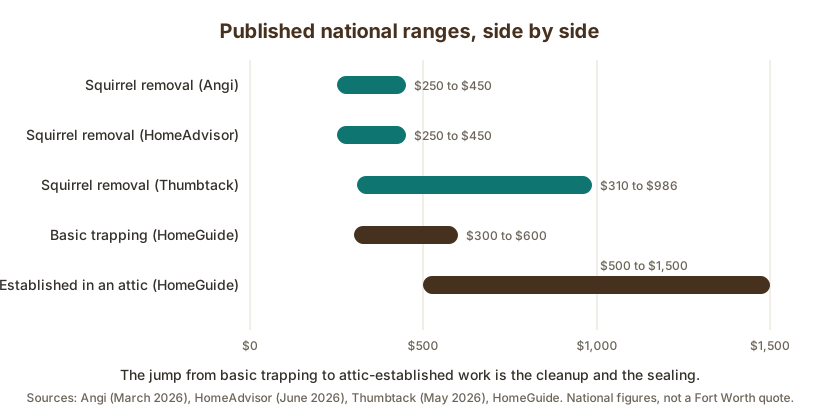
| $250 to $450, national average around $300 | Angi, March 2026 |
| $250 to $450, average around $300 | HomeAdvisor, June 2026 |
| $310 to $986 national spread | Thumbtack, May 2026 |
| $300 to $600 basic trapping and relocation; $500 to $1,500 squirrels established in an attic | HomeGuide |
The jump from basic trapping to attic-established work is the cleanup and the sealing, and it is the most important line on this page. See squirrel removal in Fort Worth.
Bat removal cost
| Published figure | Source |
|---|---|
| $250 to $600 for up to five bats, $425 national average; $600 to $1,500 for a colony of up to fifty | HomeGuide, September 2025 |
| $100 to $250 for a single bat inside the living area | HomeGuide, September 2025 |
| $100 to $400 per entry point for exclusion barriers | HomeGuide, September 2025 |
| $500 to $5,000 for guano cleanup where it is needed | HomeGuide, September 2025 |
Bat work is priced by entry points and by cleanup, not by bats, and in Texas its schedule is set by the May 1 to August 15 window that Texas Parks and Wildlife identifies. See bat removal in Fort Worth.
Dead animal removal cost
| Published figure | Source |
|---|---|
| $150 to $350 to remove and dispose of a dead raccoon | Angi, updated July 2026; HomeAdvisor, June 2026 |
That is the one species-specific figure we have found; there is no reliable published national figure for dead animal removal in general, and we are not going to invent one. Access decides it: an accessible carcass in an open attic sits at the low end, a wall cavity behind tile sits well above. See dead animal removal in Fort Worth.
Attic cleanup and insulation replacement cost
| Published figure | Source |
|---|---|
| $250 to $500 for post-removal cleaning and disinfection | Angi and HomeAdvisor, both 2026 |
| $1 to $7 per square foot to replace chewed or soiled attic insulation | HomeAdvisor, June 2026 |
| $500 to $1,500 for animal-established attic work including cleanup and sealing | HomeGuide |
| $500 to $5,000 for bat guano cleanup | HomeGuide, September 2025 |
Cleanup varies more than any other line here, because a targeted clean and a full strip and re-insulation are an order of magnitude apart. See attic cleanup and restoration in Fort Worth.
Snake, bird, skunk, opossum and armadillo removal cost
No species-specific national figure exists for these that we would stand behind. The general wildlife ranges apply: $250 to $450 with an average near $300 (Angi, March 2026; HomeAdvisor, June 2026), and a wider spread of $310 to $986 (Thumbtack, May 2026). Single-animal removal with no sealing sits below those figures; barrier and exclusion work sits above them. See snake removal, bird removal and control and skunk, opossum and armadillo removal, all in Fort Worth.
Two things stand out when you put the guides side by side. The first is how much they disagree, which tells you something real: this is a job that varies enormously by circumstance. The second is the jump from removal to attic-established work everywhere it appears. That gap is the cleanup and the sealing.
The five things that actually move the price
- What the animal is. A single snake in a garage and a bat colony in a roof are not comparable jobs. Bats and raccoons sit at the higher end because both involve more sealing and, usually, more cleanup.
- How many, and whether there are young. One animal is a job. A female with a litter is a longer job with a different sequence, because the young have to be accounted for before anything is sealed.
- Where the entry point is. Ground-level work is cheaper than roof work. A steep roof, a two-storey soffit, or a gap that needs scaffolding all cost more than a crawlspace vent, and it has nothing to do with the animal.
- How much sealing is needed. This is the biggest single variable and the one most often left out of a cheap quote. Closing one vent is not the same as closing a roofline, and installing a buried barrier around a deck is a different order of work again.
- How much cleanup is left. A clean attic and a raccoon latrine in blown insulation are separated by a large number. Guano accumulation, contaminated insulation and odor treatment all sit here. See attic cleanup and restoration.
Why the cheap quote is usually the expensive one
There is a reliable way to make a wildlife quote look low: leave out the sealing.
Trapping an animal is the least skilled and least time-consuming part of this work. If a price seems surprisingly low, the question to ask is whether it includes closing every entry point, or only removing what is currently inside. The second option leaves you with an empty attic, an open roof, and the same phone call next season.
The related question people search is why squirrel removal is so expensive. The answer is that the removal is not the expensive part. Finding every entry point, sealing at roof height with materials a rodent cannot chew, repairing chewed timber and replacing nested insulation is where the cost lives, and skipping it is what makes a job cheap and temporary.
What a quote should tell you
Worth asking of anyone, including us.
- Was the price given after an inspection, or over the phone? A number produced before anyone has seen the roof is an estimate of an unknown.
- Does it include sealing every entry point, or only the one in use?
- Does it include cleanup, and if so how much?
- Does it include repairing the damage at the entry point?
- What happens if another entry point is found once work starts?
- For bats, does the schedule account for the May 1 to August 15 window that Texas Parks and Wildlife identifies, when exclusion is discouraged because the young cannot fly?
Before you spend anything, check the free routes
Some of what people pay for does not need paying for.
Dead animals on public streets or city property are reported to the City of Fort Worth through the Customer Care Center on 817-392-1234, and Solid Waste responds to those requests. Dead or sick wild birds are referred by the City to Texas Parks and Wildlife on 512-389-4800.
What the City does not do is trap live wildlife. Its guidance states that Animal Care & Control no longer picks up or provides traps for wildlife, and names rabbits, opossums, squirrels, snakes and rats specifically. So an animal alive in your house is a paid job, and an animal dead on the road may not be.
The full picture is on free wildlife help in Fort Worth.
Get a real number
Call (571) 412-0006. An inspection is how a range becomes a price. Tell us the species if you know it, and if you do not, what animal is in my attic will get you close enough to describe it. Everything we handle is on wildlife removal in Fort Worth.
Frequently Asked Questions
How much does wildlife removal cost?
Published national guides put common jobs between roughly $250 and $600, with attic-established work running $500 to $1,500 once cleanup and sealing are included, and a wider national spread reported up to $986. Your job depends on species, access, sealing and cleanup.
How much does raccoon removal cost?
Angi (July 2026) puts the average at $400 with a range of $150 to $1,900; HomeAdvisor (June 2026) puts most jobs at $300 to $450; HomeGuide (February 2026) puts one raccoon at $200 to $300 and raccoons in an attic at $1,000 to $3,500 including sealing and disinfecting. Attic access and cleanup are the difference.
How much does dead wildlife removal cost?
The only species-specific published figure we have found is $150 to $350 to remove and dispose of a dead raccoon (Angi, July 2026; HomeAdvisor, June 2026). Beyond that it turns on access: an accessible carcass sits at the low end, and a case needing wall access and remediation sits above the general wildlife ranges. If the animal is on a public road or is a small animal outdoors on your property, the City route may cost you nothing.
Why is squirrel removal so expensive?
Because the trapping is the cheap part. The cost is in finding every entry point, sealing at roof height with materials a rodent cannot chew, repairing chewed timber and vents, and replacing nested insulation.
Do you charge for the inspection?
That is a configuration question rather than a content one, and it is answered when you call. What we will not do is quote a price before we have seen the building.
Will homeowners insurance cover any of it?
Policies vary widely on whether animal intrusion and the resulting damage are covered, and it is a question for your insurer rather than for us. It is usually worth asking specifically about the repair and cleanup rather than the removal.