Dead Animal Removal in Fort Worth
An animal has died somewhere in the structure and the smell is spreading. We find it, remove it, and treat what it leaves behind.
Who picks up dead animals in Fort Worth? Public property or private property decides it
This is the one service where the right answer might cost you nothing, so it is worth thirty seconds before you book anyone. The split is by where the animal is.
On a public street, sidewalk or city property. The City's job. Report it to the City of Fort Worth through the Customer Care Center on 817-392-1234, or through the City's online reporting route. That is the route the City publishes for dead animal reports, and Solid Waste responds to those requests.
A small dead animal outdoors on your own property. The City's published guidance states that it handles the pickup of small dead animals on city streets and on private property, so a small carcass in the yard or the driveway is reported the same way, on the same number. It costs nothing to ask.
Dead or sick wild birds, particularly where more than one is involved, are referred by the City to Texas Parks and Wildlife on 512-389-4800.
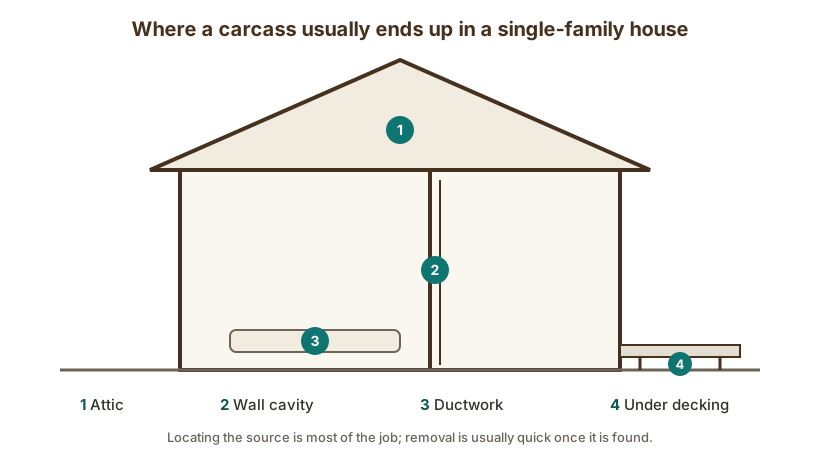
Inside your walls, attic, crawlspace or ductwork, or under a deck that has to be opened up. That is where we come in. The City's guidance is clear that Animal Care & Control no longer picks up wildlife or provides traps, and locating a carcass inside a building is a different job from collecting one off a road. Nobody at the City is coming to open your wall.
The full picture, including what else the City will and will not do, is on free wildlife help in Fort Worth.
Does animal control remove dead animals?
In Fort Worth the answer is yes for the public-property and small-outdoor-animal cases above, and no for anything inside a structure. Animal Care & Control is the City department, and dead animal reports reach it through the Customer Care Center on 817-392-1234. What it does not do is trap live wildlife or enter a building to find a carcass. If you are asking where to take a dead animal, the answer is nowhere: report it for collection if it is outdoors, and call us if it is inside.
What the smell tells you
The pattern is fairly consistent. The odor builds over two or three days, peaks, and then slowly fades over one to three weeks depending on the size of the animal and the temperature. In a North Texas summer, an attic accelerates all of that considerably.
Smaller animals in a wall cavity often produce a sharp, sweetish smell that seems to move around the house as air circulates. Larger animals in an attic produce something heavier that settles into fabric and insulation.
Two secondary signs are worth knowing. Flies appearing indoors in one room, particularly at a window, often point to the cavity behind that wall. And a stain appearing on drywall or a ceiling is a late sign, not an early one.
How we find it
Locating is most of this job. The removal itself is usually quick once the source is found.
Narrow it by air. Which room, which wall, whether it is stronger high or low, whether it changes with the air conditioning running. This is why we ask you those questions on the phone.
Inspect the accessible spaces. Attic, crawlspace, garage, ductwork, behind appliances, under decking.
Work the cavity. If it is inside a wall, access has to be made at the right point. We would rather make one considered opening than four hopeful ones, which is why the locating step is not rushed.
Remove and dispose of the carcass properly.
Treat the area. Removal alone does not end an odor. Contaminated insulation, absorbed material and the residue at the site all need dealing with, and so does the possibility of a secondary insect problem.
Call (571) 412-0006 and describe the smell and which room is worst.
Contact UsThen find out why it happened
An animal that dies inside a structure got in somehow, and whatever it used is still open.
This is the part people skip when they are focused on the smell, and it is the reason some houses get a second call the following year. If we remove a carcass, we look for the entry point while we are there, because the same gap is an invitation to the next animal.
If poison was used before we arrived, that is worth telling us. An animal that ingests rodenticide and then dies inside a wall is one of the most common ways this problem starts, and knowing it happened tells us where to look.
Sealing is covered on wildlife exclusion, and attic contamination on attic cleanup and restoration.
What dead animal removal costs
Cost here is driven almost entirely by access. A carcass in an open attic is straightforward. One inside a wall cavity behind tiled surfaces, or under a deck that has to be partly lifted, is not. Size matters too, and so does how much material has been contaminated.
The one species-specific published figure we have found is for raccoons: Angi (updated July 2026) and HomeAdvisor (June 2026) both put removal and disposal of a dead raccoon at $150 to $350. For general wildlife work, the aggregator figures run $250 to $450 with an average near $300 (Angi, March 2026; HomeAdvisor, June 2026), with a wider national spread of $310 to $986 reported by Thumbtack. An accessible carcass in an open attic sits at the low end of all of that. A case needing wall access and remediation sits above it.
We give you a real number once we know where it is. See what dead animal removal costs.
What not to do while you wait
Do not mask it. Air fresheners and plug-ins bind to soft furnishings and leave you with two smells instead of one.
Do not assume it will simply pass. It will fade eventually, but the contaminated material stays, and so does whatever gap let the animal in.
Do not open up drywall on a guess. Once you have made three holes in the wrong places you still have the smell, plus the repairs.
Get it located
Call (571) 412-0006. Tell us which room is worst, whether it is stronger near the floor or the ceiling, and roughly what day you first noticed it. The contact form reaches us the same way. Dead animal work is one part of our wildlife removal in Fort Worth service.
Frequently Asked Questions
Who do I call for dead animal removal in Fort Worth?
It depends where it is. On a public street, city property, or a small animal outdoors on your own property, report it to the City's Customer Care Center on 817-392-1234. Inside your walls, attic or crawlspace, call a wildlife company. That is us, on (571) 412-0006.
Who picks up dead animals in Fort Worth?
The City handles reports made through the Customer Care Center, with Solid Waste responding to those requests, and its guidance covers small dead animals on city streets and private property. Dead or sick wild birds are referred to Texas Parks and Wildlife on 512-389-4800. Anything inside a building is a wildlife company.
What do I do if I find a dead animal in my backyard?
Do not handle it directly. For an animal on your own property, a wildlife company can remove and dispose of it. If the animal is a bird, or if several animals are involved, the Texas Parks and Wildlife number above is the right first call.
How long does the smell last if I do nothing?
Usually one to three weeks, depending on the size of the animal and the temperature, and considerably faster to peak in a hot attic. The contaminated material and the entry point both remain afterwards.
Do you find the entry point as well?
Yes, we look for it while we are there. Something got in, and whatever it used is still open. See wildlife exclusion.