Raccoon Removal in Fort Worth
If something heavy is moving around above your ceiling after dark, a raccoon is the most likely answer. We get it out, seal the way it came in, and deal with the mess it made.
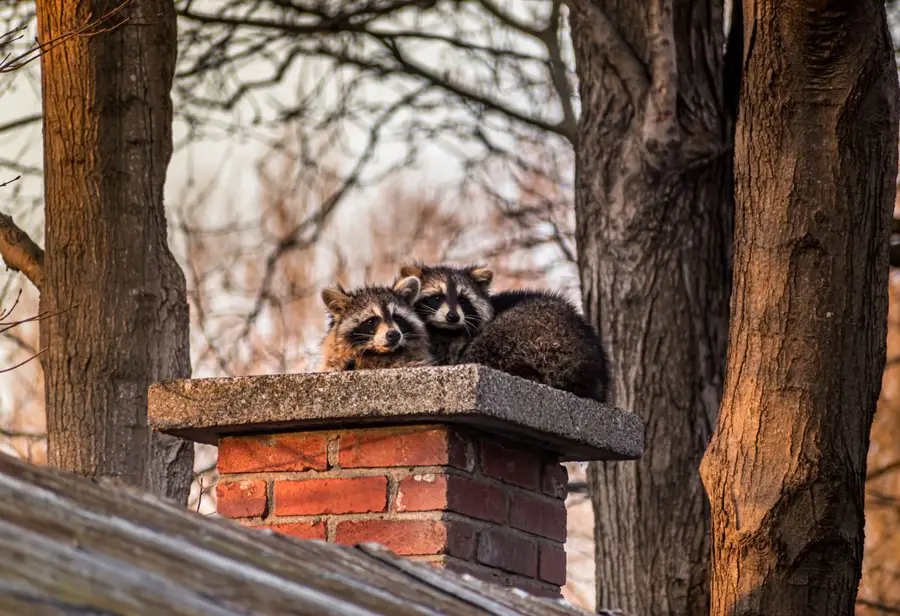
How you know it is a raccoon and not something lighter
Raccoons are big. An adult commonly runs ten to twenty-five pounds, and it sounds like it.
- Weight. Thumping and dragging, not scampering. People often describe it as sounding like a person crawling.
- Timing. Activity starts around dusk and again before dawn. Squirrels do the opposite.
- Vocal. Chittering, growling, or a set of small trilling noises. That last one usually means kits.
- Entry damage that is visible from the ground. A pulled-back soffit corner, a torn roof edge, a gable vent pushed in, a bent turbine vent. Raccoons have hands and they use them.
- Droppings in clusters, often in one chosen spot rather than scattered.
If none of that quite fits, work through what is in my attic first.
Why raccoons are worth moving quickly on
A squirrel in an attic is a problem. A raccoon in an attic is a faster problem.
They open a hole and then keep opening it, so the roof damage grows. They flatten and soil insulation across a wide area rather than nesting in one corner. They pull at ductwork. They use one latrine spot repeatedly, and raccoon latrines are the reason attic cleanup after raccoons is a proper job rather than a sweep up.
Spring litters raise the stakes. A female with kits will not leave, and will work harder at the structure while she is nursing. Removing the adult and sealing the gap while the young are still inside is the worst outcome available, for the animals and for your ceiling.
What Texas law actually allows here
This matters more with raccoons than with any other animal we handle, and it is the part most websites get wrong.
Raccoons are fur-bearing animals under Texas Parks and Wildlife rules, along with opossums, skunks, foxes, beavers and several others.
On your own property. Texas Parks and Wildlife states that landowners or their agents may take nuisance fur-bearing animals in any number, by any means, at any time, on that person's land, without needing a hunting or trapping licence. The department adds a condition to that: fur-bearing animals or their pelts taken for these purposes may not be retained or possessed by anyone at any time, except by licensed trappers during the lawful open season and possession periods.
On relocation. The department states that nuisance fur-bearers may be captured and relocated only if the person has received authorisation from the department and permission from the owner of the property where the release will happen, and a monthly report of what was captured and where it was released must be submitted.
On moving a live raccoon anywhere. Separately, under a statewide rabies quarantine, Texas Parks and Wildlife states that it is a Class C misdemeanour to transport or sell live foxes, coyotes and raccoons from, to, or within this state.
Those are two separate provisions and we are not going to pretend to resolve how they interact in every case. What we can say is that neither of them describes a simple, on-request "we will catch it and let it go in the countryside" service: one attaches conditions to relocation, and the other attaches a criminal penalty to moving a live raccoon. If a company offers you that outcome, it is fair to ask which authorisation it holds.
This is a plain-language summary of what the department publishes, not legal advice. The current wording is in the Texas Parks and Wildlife Outdoor Annual, which is the source we work from and the one to check if you want the detail.
Call (571) 412-0006 and describe the noise and the time of day it happens.
Contact UsSo what do we actually do
We work the problem in the order that keeps the animal count in your attic at zero permanently, rather than at zero for a season.
Inspect first. We find every entry point, not just the obvious one, and we establish whether there are kits. This is the step that dictates everything after it.
Get the animals out. Method depends on what we find, on whether young are present, and on what the law allows for the species. We explain the plan before we carry it out, and we do not describe it in vague language.
Seal the building. Every gap in use and every gap about to be. Raccoons return to a known roof, so a sealed entry point is not a nicety, it is the job. Details on wildlife exclusion.
Clean up. Latrine areas, soiled insulation, odor, and the structural damage from the entry point. See attic cleanup and restoration.
What raccoon removal costs
The honest answer is that it depends on how many, where, and how much damage. Roof-height entry points cost more than a ground-level crawlspace. A latrine in blown insulation costs more than a single animal in a clean attic. Kits change the timeline.
National cost guides put raccoon removal around $250 to $450 for straightforward work, with a national average near $300 (Angi, March 2026), and HomeGuide puts attic-established animals in the $500 to $1,500 band once cleanup and sealing are included. Thumbtack's national spread is wider at $310 to $986.
We quote after we have looked. The full picture, including the attic and cleanup figures the national guides publish, is on what raccoon removal costs.
Before you call us, one thing worth checking
If the raccoon is dead, or on public property, that may be a City matter rather than a paid job. Fort Worth handles dead animal reports through its Customer Care Center on 817-392-1234. What the City does not do is trap live wildlife: its guidance states Animal Care & Control no longer picks up wildlife or provides traps. Details on free wildlife help in Fort Worth.
Get the attic looked at
Call (571) 412-0006 and tell us when you hear it and how heavy it sounds. Or send the contact form with the same detail. Raccoons are one part of our wildlife removal in Fort Worth service.
Frequently Asked Questions
Who can I call in Fort Worth about a raccoon?
A wildlife control company. The City no longer traps wildlife or lends traps, and points residents to search for animal rescue and removal services. Call (571) 412-0006.
Is it legal to kill a raccoon in Texas?
Texas Parks and Wildlife states that landowners or their agents may take nuisance fur-bearing animals, which includes raccoons, in any number by any means at any time on their own land, without a hunting or trapping licence. The department also states that animals or pelts taken that way may not be retained or possessed, except by licensed trappers during the lawful open season. Rules differ off your own property, and the relocation and transport provisions apply separately. This is a summary of published guidance, not legal advice.
Can you catch it and release it somewhere else?
Not as a simple on-request service. Texas Parks and Wildlife states that relocating a nuisance fur-bearer requires prior authorisation from the department plus the release-site owner's permission and a monthly report, and separately that a statewide rabies quarantine makes it a Class C misdemeanour to transport or sell live foxes, coyotes and raccoons from, to, or within the state.
There are babies in the attic. What happens?
We establish that during the inspection, because it changes the plan. Sealing an entry point with kits behind it is the outcome we work to avoid.
Will the insulation need replacing?
Often, where there is a latrine or widespread soiling. We assess it as part of the inspection rather than assuming. See attic cleanup and restoration.