Bat Removal in Fort Worth
Bat work in Texas is governed by two things most homeowners have never been told: bats are protected, and there is a window in the year when sealing them out is the wrong thing to do. Both are worth understanding before you hire anyone, including us.
The date range that decides how your job runs
Texas Parks and Wildlife states that excluding bats from buildings is discouraged from May 1 to August 15, because during that period the young cannot yet fly and would be trapped inside if the entry point were sealed.
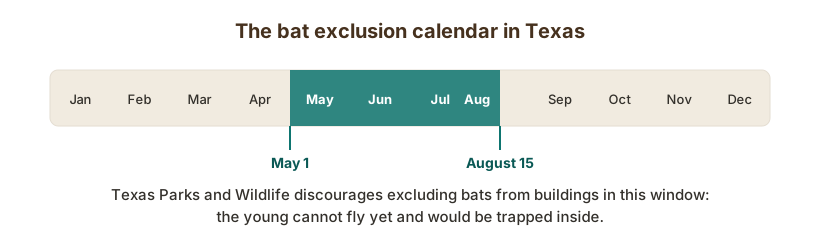
That is the whole reason bat jobs are not simply booked in the order they come in. Seal a roost in June and you have walled flightless pups into your attic. What follows is an odor problem, a cleanup problem, and a set of adult bats trying to chew and squeeze their way back to young that cannot leave.
So if you call us in that window, the first conversation is about timing, not about price. Some work can still be done: inspection, identifying entry points, planning the exclusion, and sealing every gap that is not in use so the roost cannot expand. The final exclusion waits until the young can fly.
Outside that window, the job runs normally.
What Texas law says about bats
The relevant rule from Texas Parks and Wildlife is short and worth quoting accurately, because it is routinely paraphrased badly.
Bats may not be hunted, killed, possessed, purchased or sold. However, bats may be moved, trapped, or killed if inside or on a building occupied by people. A person may transport a bat for laboratory testing where there is a rabies or white-nose syndrome concern.
Two practical consequences. First, you are not powerless about bats in your own house; the department's wording makes specific room for exactly that situation. Second, the same protection means bat work outside that situation is not a free-for-all, and a company treating bats as generic pests is telling you something about its standards.
Note the department's own word for the May 1 to August 15 period is discouraged, not prohibited. We treat it as decisive for scheduling because sealing flightless young inside a building is a bad outcome by any measure, but we are describing published guidance and our own practice, not legal advice. Texas Parks and Wildlife's Outdoor Annual is the source to check.
Call (571) 412-0006. If it is between May and mid-August, say so, because it changes the plan.
Contact UsHow bat exclusion actually works
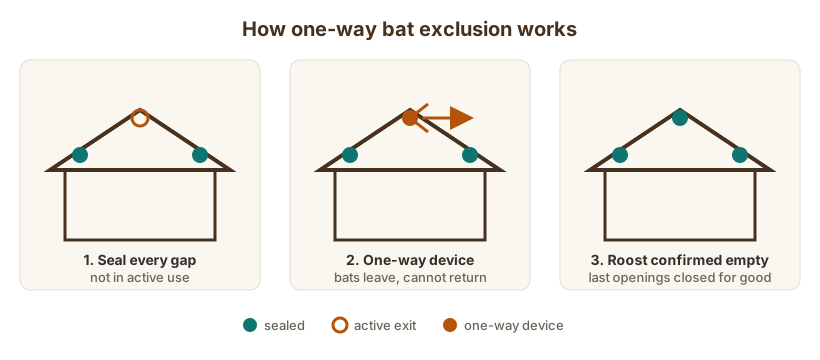
Bats are not trapped and carried away. They are excluded, which means the building is made one-way.
Inspect. We find the roost and, more importantly, every gap being used to reach it. Bats use openings far smaller than people expect, and a roost usually has more than one.
Seal everything that is not an exit. All the gaps that are not in active use get closed first, so the number of ways in drops to a known, controlled set.
Fit one-way devices at the active exits. Bats leave to feed and cannot get back in.
Confirm the building is empty, then close the last openings permanently.
Clean up. Guano, staining, and contaminated insulation. Guano is bat droppings, and it accumulates below a roost. Handling it is not a broom job: it is done with proper protection and disposal. See attic cleanup and restoration.
The exclusion step is the same discipline we apply to every species, and it is covered in full on wildlife exclusion.
Bat control, bat exterminator, bat removal: what people search for and what the job actually is
People search for bat control, a bat exterminator, bat pest control and bat removal, and companies advertise under all four names. Texas law is the reason we use one word for the work: exclusion.
Bats are protected, and the department's permission to move, trap or kill a bat applies inside or on a building occupied by people. A company describing itself as a bat exterminator is describing a job the law does not generally provide for, and a company that treats bats as a pest-control spray job has not read the rule. What can lawfully be done, and what actually works, is making the building one-way, closing it once the bats have left, and dealing with the guano. Whatever you searched for to get here, that is the job, and the calendar above governs when it runs.
Signs you have bats rather than something else
- Sound. Light chittering, scratching or rustling, usually strongest at dusk and again near dawn. Quieter and higher-pitched than a squirrel or a rat.
- Sight. Bats leaving a specific point of the roofline at dusk. Standing outside at sunset and watching is genuinely the best diagnostic available.
- Staining. A dark, greasy smudge at a gap, from fur rubbing the same edge repeatedly.
- Droppings. Small, dark, and crumbly, usually piled directly below the entry point or the roost rather than scattered.
- Odor. A distinctive ammonia smell as guano builds up.
If that does not match, work through what is in my attic.
What waiting costs you
Bats are not destructive in the way a raccoon is. Nothing gets chewed, nothing gets torn open, and the noise is easy to live with. That is exactly why bat problems get left, and why the ones we see have usually been there a while.
What accumulates instead is guano. It builds directly below the roost, it holds moisture, and it produces an ammonia smell that gets into insulation and then into the rooms below. The staining at the entry gap spreads. Insulation under the roost stops being insulation and starts being something that has to be removed and replaced, which turns a sealing job into a sealing and restoration job.
The other thing that grows is the colony itself. A roost that suits bats this year suits them next year, and the sensible time to close it is the first season you notice, not the third.
None of that is a reason to rush the timing. It is a reason to get it inspected now and scheduled properly, which are two different things.
Emergency bat removal: a bat in the house right now
Different situation, and the one behind most of the urgent calls we get. A bat flying around a bedroom late at night is not a colony job, and it is handled differently from a roost inspection.
Before anyone arrives. Close the interior doors so the bat is contained in one room, and keep children and pets out of it. If you can do it safely, open a window or an exterior door in that room and turn the lights off: the U.S. Fish and Wildlife Service notes that a bat will usually find its own way out through an open door or window, and that turning indoor lights off in the evening helps it navigate. Do not swing at it and do not try to catch it with bare hands. Then call (571) 412-0006 and say the bat is inside the living space.
The question that matters more than the bat. If there is any possibility that a person was bitten, scratched or touched, particularly someone who was asleep, a child, or anyone who cannot say whether contact happened, the bat should not be released. The CDC states that bat bites can be tiny and may go unnoticed, that anyone who thinks they have been in contact with a bat should talk to their health department, and that a bat found in the home should be captured for rabies testing and not released until a public health expert has been consulted. Texas Parks and Wildlife's own rule makes specific room for this: a bat may be transported for laboratory testing where there is a rabies concern. Treat it as a medical question first and a wildlife question second. We are the second call.
What we do on an emergency bat call. Contain and remove the bat, without releasing it where exposure is possible, and hand it over for testing where the health department asks for that. Then the part that stops it happening again: a bat in a bedroom almost always came from a roost in the same building, so we look for the gap between the roost space and the living space and close it, and we look for the roost. That second half is ordinary bat exclusion, on the timing rules above.
The full walk-through for the next hour, including what to do when the bat has disappeared into the room, is on a bat in the house: what to do right now.
What bat work costs
Bat exclusion is usually not the cheapest job on our list, and the reason is that it is mostly sealing, at height, done thoroughly, with a return visit built in.
The cost drivers are the number of entry points, the height and pitch of the roof, the size of the roost, whether guano cleanup and insulation replacement are needed, and whether the timing rules require the work to be staged.
National cost guides give ranges for wildlife and attic work generally rather than for bat exclusion specifically: Angi and HomeAdvisor put common wildlife removal at $250 to $450 with an average near $300, HomeGuide puts attic-established work at $500 to $1,500, and Thumbtack's national spread runs $310 to $986. Bat exclusion with guano remediation sits toward the upper end of that picture more often than not.
We give you a number after inspecting. See what wildlife removal costs.
Get the roofline looked at
Call (571) 412-0006. If you have watched them come out at dusk, tell us where from. That single observation saves a lot of time. Bats are one part of our wildlife removal in Fort Worth service; the rest is on that page.

Frequently Asked Questions
Who do I call for a bat in my house right now?
Contain it in one room, then call (571) 412-0006 and say it is inside the living space. If anyone may have been bitten, scratched or touched, the CDC's guidance is to have the bat captured for rabies testing rather than released and to contact your health department, and that comes before the wildlife call.
Are bats protected in Texas?
Yes. Texas Parks and Wildlife states that bats may not be hunted, killed, possessed, purchased or sold, but that they may be moved, trapped or killed if inside or on a building occupied by people.
When can bats be excluded from a building in Texas?
Texas Parks and Wildlife states that excluding bats from buildings is discouraged from May 1 to August 15, because the young cannot fly during that period and may be trapped inside. Outside that window, exclusion proceeds normally.
Does animal control remove bats?
Fort Worth's Animal Care & Control does not trap wildlife or provide traps, and its guidance directs residents to search for animal rescue and removal services. Wildlife rescue and rehabilitation questions go to 817-392-1234.
Is bat guano dangerous?
It is treated as a contaminated material and handled with protection and proper disposal rather than swept up. Accumulated guano also produces a persistent ammonia odor and can soak into insulation, which is why cleanup is usually part of the job.
Will homeowners insurance pay for bat removal?
That is between you and your insurer, and policies vary widely on whether animal intrusion and the resulting damage are covered. It is worth asking them specifically about the cleanup and repair rather than the removal itself. We cannot answer for any policy.